Abstract
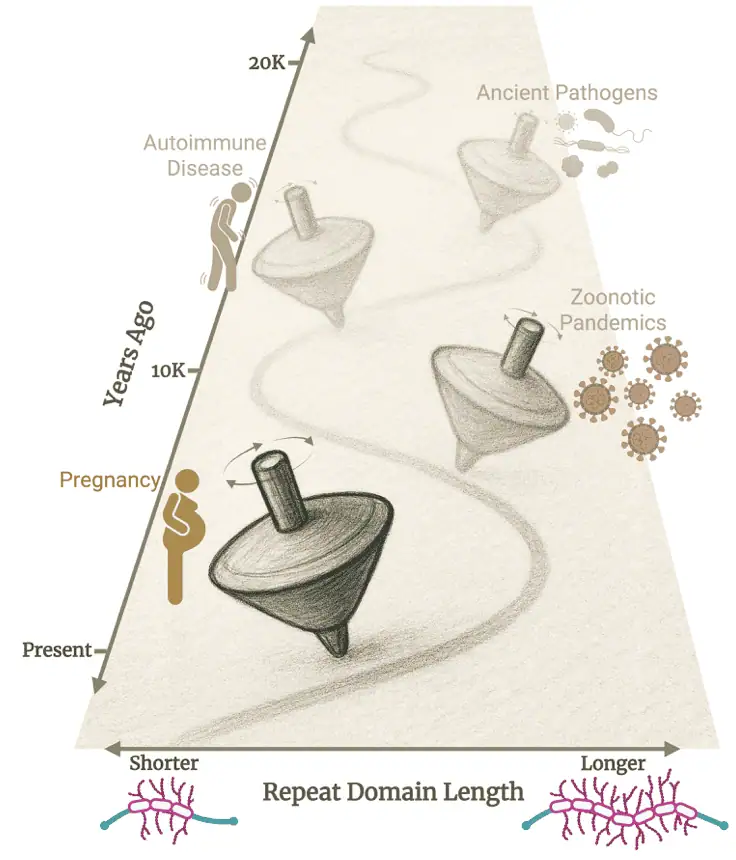
Understanding genomic function has historically relied on sequence conservation across evolutionary time. However, functional innovations often arise from rapidly evolving, nonconserved elements. Variable number tandem repeats (VNTRs) act as engines of both functional innovation and phenotypic consequence, influencing gene regulation, protein structure, and phenotypic diversity. This review synthesizes emerging insights into the functional and evolutionary impact of VNTRs in mammals, outlining the mutational mechanisms driving their evolution, the selective forces maintaining structural heterogeneity, and a theoretical framework for their persistence through evolutionary tradeoffs.
Understanding genomic function has historically relied on sequence conservation across evolutionary time. However, advances in genomics have revealed that functional innovations often arise from rapidly evolving, nonconserved elements that are frequently overlooked by conservation-based approaches. Among these, variable number tandem repeats (VNTRs) act as engines of both functional innovation and phenotypic consequence. VNTRs are repetitive genomic sequences whose copy numbers can vary significantly between individuals and species, influencing gene regulation, protein structure, and eventually, phenotypic diversity.
Recent long-read assemblies and pangenomes now resolve VNTR loci accurately, enabling robust evolutionary reconstruction and functional associations. Here, we synthesize emerging insights into the functional and evolutionary impact of VNTRs in mammals. Specifically, we outline pressing questions on the mutational mechanisms driving VNTR evolution in humans, the selective forces maintaining their structural heterogeneity, and propose a theoretical framework for their persistence through evolutionary tradeoffs.
Key insights include VNTRs’ roles in modulating traits such as skin barrier function (FLG), height (ACAN), behavior (MAOA), and pathogen defense (mucin genes). We propose a framework centered on evolutionary tradeoffs, suggesting that balancing selection maintains VNTR variation, enabling adaptive benefits while also potentially causing disease susceptibility.