Contributing to science, one puzzle piece at a time.
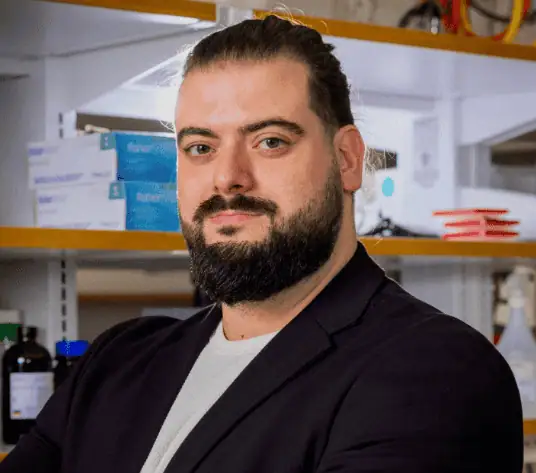
I am an NSF Postdoctoral Fellow at Yale University with a Ph.D. in evolutionary genetics. I recently joined the lab of Dr. Stacy Malaker to gain expertise in glycoproteomics. I am broadly curious how genomic structural variants, commonly found in human genomes, contribute to evolution, function, and disease susceptibility.
Four threads, one question
How structural variation shapes genome evolution, function, and disease.
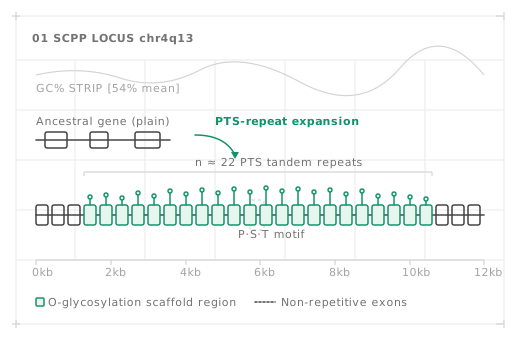
Mucins. How evolution builds the slippery, sugar-coated proteins that make mucus.
Explore →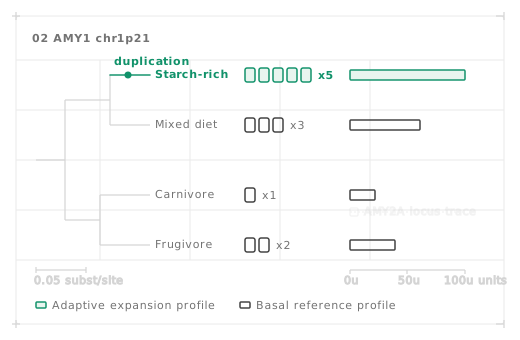
Saliva. The mouth's first line of defense as a window into dietary adaptation.
Explore →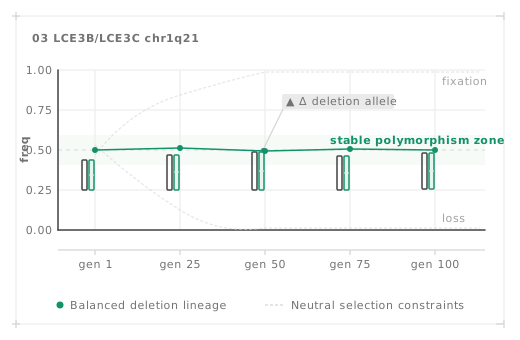
Evolutionary Tradeoffs. Why evolution keeps disease-linked genetic variants around.
Explore →
Glycoproteomics. Reading the sugar code on proteins to understand function and disease.
Explore →Research that rewrites how we read the genome
Evolutionary Balancing of Genetic Consequence and Innovation in Mammals Through Variable Number Tandem Repeats
Read paper → GenomicsReconstruction of the Human Amylase Locus Reveals Ancient Duplications Seeding Modern-Day Variation
Read paper → MucinsA Mechanism of Gene Evolution Generating Mucin Function
Read paper →What's new
Evolutionary Balancing of Genetic Consequence and Innovation in Mammals Through Variable Number Tandem Repeats
Understanding genomic function has historically relied on sequence conservation across evolutionary time. However, functional innovations often arise from rapidly evolving, nonconserved elements. Variable number tandem repeats (VNTRs) act as engines of both functional innovation and phenotypic consequence, influencing gene regulation, protein structure, and phenotypic diversity. This review synthesizes emerging insights into the functional and evolutionary impact of VNTRs in mammals, outlining the mutational mechanisms driving their evolution, the selective forces maintaining structural heterogeneity, and a theoretical framework for their persistence through evolutionary tradeoffs.
Read more →Saliva Protein Genes in Humans Were Shaped During Primate Evolution
The secretory calcium-binding phosphoprotein (SCPP) gene family, which includes genes expressed abundantly in human saliva, evolved alongside major evolutionary milestones in vertebrates. We explored the evolution of saliva-related SCPP genes using genomic and transcriptomic resources, finding previously undocumented convergent gene duplications in primate genomes. These saliva-related genes show signatures of positive selection while neighboring genes remain conserved, suggesting dietary and pathogenic pressures drove adaptive diversification of saliva composition in primates, including humans.
Read more →Exciting Milestone: NSF Fellowship to Explore Mucus Evolution and Pregnancy
I've been awarded a prestigious Postdoctoral Research Fellowship in Biology (PRFB) from the National Science Foundation, joining Dr. Stacy Malaker's lab at Yale University to study glycoproteomics and the evolutionary genetics of mucins.
Read more →Tuning the Tropism and Infectivity of SARS-CoV-2 Virus-Like Particles for mRNA Delivery
SARS-CoV-2 virus-like particles (VLPs) are ~100-nm bioinspired mimetics of the authentic virus, engineered here as a platform for mRNA delivery. A three-plasmid VLP system displayed ~7-fold higher viral entry efficiency than four-plasmid co-transfection, transducing over 90% of human ACE2-expressing cells. Viral tropism could be reprogrammed by swapping glycoproteins from other viral strains, and VLPs carried up to four transgenes, including functional Cas9 mRNA for genome editing, with successful delivery to mouse lungs.
Read more →Major Publications Highlight My New Paper – Reconstruction of the Human Amylase Locus
My latest paper on the evolutionary history of the AMY1 gene has garnered significant attention from CNN, The New York Times, and scientists in the field, shedding light on how our ancestors adapted to carbohydrate-rich diets long before the advent of agriculture.
Read more →