Many structural variants that persist in human genomes do so because they balance competing selective pressures — an advantage in one context offset by a cost in another. I study balancing selection and structural variation as a lens on disease susceptibility.
Petar Pajic · Genome Biology and Evolution · Jan 1, 2026 Journal Understanding genomic function has historically relied on sequence conservation across evolutionary time. However, functional innovations often arise from rapidly evolving, nonconserved elements. Variable number tandem repeats (VNTRs) act as engines of both functional innovation and phenotypic consequence, influencing gene regulation, protein structure, and phenotypic diversity. This review synthesizes emerging insights into the functional and evolutionary impact of VNTRs in mammals, outlining the mutational mechanisms driving their evolution, the selective forces maintaining structural heterogeneity, and a theoretical framework for their persistence through evolutionary tradeoffs.
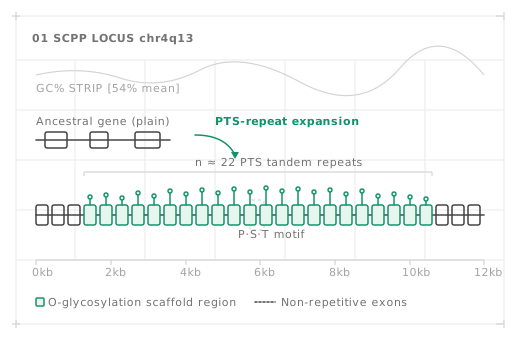
Petar Pajic · Genome Biology and Evolution · Aug 22, 2025 Journal The secretory calcium-binding phosphoprotein (SCPP) gene family, which includes genes expressed abundantly in human saliva, evolved alongside major evolutionary milestones in vertebrates. We explored the evolution of saliva-related SCPP genes using genomic and transcriptomic resources, finding previously undocumented convergent gene duplications in primate genomes. These saliva-related genes show signatures of positive selection while neighboring genes remain conserved, suggesting dietary and pathogenic pressures drove adaptive diversification of saliva composition in primates, including humans.
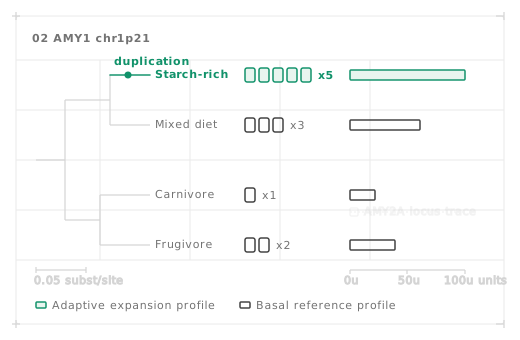
Petar Pajic · Science · Oct 24, 2024 Journal Human adaptation to a wide range of diets is a hallmark of our species, sometimes even reflected in our genomic diversity. The amylase gene encodes an enzyme that digests starch, a complex carbohydrate found in many modern human diets. Genomic studies have found substantial variation in the number of amylase gene copies, believed to be an adaptive response to dietary changes among human populations after the advent of agriculture. We reconstruct the locus's evolutionary history, tracing duplications that predate agriculture and seeded modern structural variation.
Petar Pajic · bioRxiv · Nov 28, 2023 Preprint Starch digestion is a cornerstone of human nutrition, and the amylase enzyme plays a key role in starch metabolism. The copy number of the human amylase gene (AMY1) has been associated with metabolic diseases and adaptation to agricultural diets. We show that amylase gene duplications originated over 700,000 years ago, predating the human-Neanderthal divergence, and likely primed the locus for rapid dietary adaptation during the agricultural transition through nonallelic homologous recombination.
Petar Pajic · Communications Biology · Jul 3, 2023 Journal Chemosensation (olfaction, taste) is essential for detecting and assessing foods, such that dietary shifts elicit evolutionary changes in vertebrate chemosensory genes. We explore the effects of subsistence behaviors on olfactory and taste receptor genes among rainforest foragers and neighboring agriculturalists in Africa and Southeast Asia, analyzing 378 functional OR and 26 functional TASR genes across 133 individuals. We find no evidence of relaxed selection in agricultural populations but identify subsistence-related signatures of local adaptation within each geographic region.
Petar Pajic · Science Advances · Aug 26, 2022 Journal How novel gene functions evolve is a fundamental question in biology. Mucin proteins, a functionally but not evolutionarily defined group of proteins, allow the study of convergent evolution of gene function. By analyzing the genomic variation of mucins across a wide range of mammalian genomes, we propose that exonic repeats and their copy number variation contribute substantially to the de novo evolution of new gene functions, identifying 15 undescribed instances of evolutionary convergence in mucin origin.
Petar Pajic · eLife · May 14, 2019 Journal The amylase gene (AMY), which codes for a starch-digesting enzyme, underwent several gene copy number gains in humans, dogs, and mice, possibly along with increased starch consumption during the evolution of these species. We present comprehensive evidence for AMY copy number expansions that independently occurred in several mammalian species which consume starch-rich diets, and provide correlative evidence that AMY duplications may be an essential first step for amylase to gain expression in saliva.
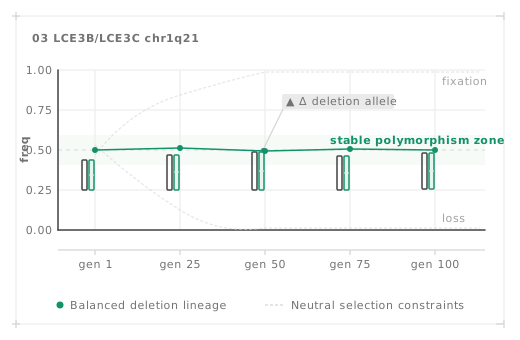
Petar Pajic · BMC Ecology and Evolution · Dec 5, 2016 Journal A common, 32kb deletion of LCE3B and LCE3C genes is strongly associated with psoriasis and is ancient, predating Human-Denisovan divergence. We show that the haplotype harboring the deletion retains high allele frequency among extant and ancient human populations, harbors unusually high nucleotide variation, and has an unusually long coalescence time, consistent with the LCE3BC deletion having evolved under balancing selection — possibly a tradeoff between autoimmunity and pathogen exposure.